For some reason I was thinking about an interesting fact earlier today: The last time Massachusetts elected any Republicans to the House or Senate was 1994. Today Massachusetts has 10 D representatives and 2 D senators. Are there any other states so single-party on a federal level?
When people think of rock-ribbed Republican states, they think of states like...Utah. Home of Jim Matheson, D-UT-02. (That is, he is a Democrat from the second district of Utah.) Wyoming? Gary Trauner lost by only a few percent in 2008, and by circa 1000 votes in 2006, for Wyoming's at-large House seat. (At-large means a state only has one House seat.) Idaho? Walt Minnick, D-ID-01. Also, four-term Senator Frank Church. Let's see, what else...The only federal-level Republican from both Dakotas is Senator John Thune of South Dakota. North Dakota's delegation is all Democratic, mostly because of the lingering influence of the NPL. Nebraska divides its electoral votes by congressional district, and Obama won in the Second CD (Omaha). Kansas has a D representative, Dennis Moore, and so does Oklahoma (Dan Boren).
Any other Republican states? All the southern states have at least one Democratic representative, mostly because they are required by the Voting Rights Act to have black majority districts. So as a consequence we have Bennie Thompson, Artur Davis, John Lewis, Jim Clyburn, etc. Can't forget Texas, that state is pretty damned Republican. Plenty of Democratic representatives, again mostly from (minority) - majority districts. Texas might elect a Democratic senator in the not too distant future, but that is a subject for another post.
Democratic states! Can't forget Vermont, which elected a socialist senator in 2006. Last Republican elected federally was Jim Jeffords in 2000, who later started caucusing with the Democrats. Rhode Island also elected a Republican in 2000, Lincoln Chafee - he was defeated in 2006. Both Jeffords and Chafee were of that vanishingly rare breed the Liberal Republican. Chafee endorsed Obama in 2008. New York has Republican parts Upstate and Illinois has Republican parts Downstate. California is very Republican once you get away from the coast. Maryland has one Republican representative. Hawaii is mostly one party, except...
I've noticed something interesting. A lot of "red states" elect Democratic governors, and vice versa.
"Blue states" with Republican governors: Hawaii, Vermont, Connecticut, California, Rhode Island, and if I turned the clock back three years, I could add New York and Massachusetts.
"Red states" with Democratic governors: Wyoming, Kansas, Oklahoma, Tennessee
...Anyway, might as well answer my initial question. As far as Republican states, Utah is pretty one party. It has a D representative, but I cannot imagine a D winning statewide. I would say the same for Idaho and most states in the South. Utah and Idaho both have large Mormon blocs, and generally Democrats in the South are minorities with political views that the white Republicans disagree with. Democratic states: A lot of the really Democratic states do have Republican governors, but they have no Republican bench: that is, the congressional delegation and state legislature are overwhelmingly Democratic. Why do they elect Republican governors sometimes? For balance, perhaps. To keep the legislature in check. Often the Republicans are from outside government, they are businessmen. Anyway.
One more day in Houston and then I fly back on Saturday.
Thursday, January 15, 2009

Wednesday, January 14, 2009
Maps
A few hours ago I was looking at the Strange Maps site again, and a few minutes ago it occurred to me that I had no topic for a blog entry. That site is oddly addictive. (Check out the Atlas of True Names entry.)
Our family owns the Times of London Concise Atlas of the World for some reason. It makes fine bedtime reading. Australia's names are perhaps my favorite: Brandon, Ayr, Home Hill, Merinda, Bowen, Airlie Beach, Cannonvale, Proserpine, Bloomsbury, Calen, Farleigh, Bakers Creek, Eungella, Moranbah, Saraji, Capella, Emerald, Anakie, Bogantungan, Alpha, Jericho, Yalleroi, Blackall. How did they all get their names? Why would the Founding Convicts of Australia name a town after the brightest star in Auriga, or the first letter in the Greek alphabet, or the wife (I guess) of Hades/Pluto? Did George Lucas look at the same map when he was writing Star Wars? (If you're curious, all the towns I named are from Queensland.)
Another atlas our family owns is the Onion's Our Dumb World. Texas, for instance, is home to "Massive pickup truck picking up smaller pickup truck", "Cowboy hat that can be seen from outer space", "Racist eating at fantastic Mexican restaurant", and "Oil man who hates all non-Saudi foreigners." The atlas also informs me that "Everything Sucks Bigger in Texas", so screw the Onion.
The political season also provided some fine maps, and the finest map I've seen is Daily Kos's Electoral Scoreboard. Whenever I need to remind myself how much butt the Democrats kicked, I look at those maps. And in 2010 (midterm midtacular!) I can use the Cook Political Report to see what the current conventional wisdom is. (Answer: Sucky. OK-Sen is likely R? It's solid R. LA-Sen is tossup? It's likely R. NH-Sen is likely R? It's lean R or tossup.)
I enjoy tracking hurricanes during hurricane season, so here are historical hurricane tracking maps. (During hurricane season I'll have to write an entry showing really bizarre hurricane tracks.) Weather maps are also interesting to me, but there are plenty of those online or in the paper. I understand Philadelphia will be freezing when I return. (Even Houston froze last night in some parts.)
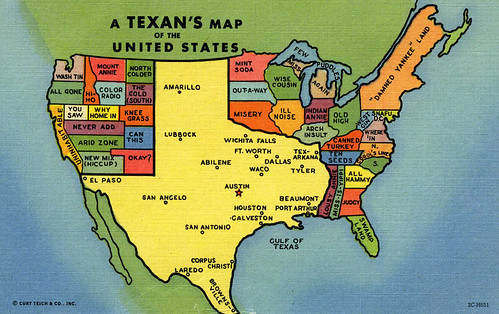
Pretty accurate map of the US.
Good night, and have a pleasant tomorrow!
Our family owns the Times of London Concise Atlas of the World for some reason. It makes fine bedtime reading. Australia's names are perhaps my favorite: Brandon, Ayr, Home Hill, Merinda, Bowen, Airlie Beach, Cannonvale, Proserpine, Bloomsbury, Calen, Farleigh, Bakers Creek, Eungella, Moranbah, Saraji, Capella, Emerald, Anakie, Bogantungan, Alpha, Jericho, Yalleroi, Blackall. How did they all get their names? Why would the Founding Convicts of Australia name a town after the brightest star in Auriga, or the first letter in the Greek alphabet, or the wife (I guess) of Hades/Pluto? Did George Lucas look at the same map when he was writing Star Wars? (If you're curious, all the towns I named are from Queensland.)
Another atlas our family owns is the Onion's Our Dumb World. Texas, for instance, is home to "Massive pickup truck picking up smaller pickup truck", "Cowboy hat that can be seen from outer space", "Racist eating at fantastic Mexican restaurant", and "Oil man who hates all non-Saudi foreigners." The atlas also informs me that "Everything Sucks Bigger in Texas", so screw the Onion.
The political season also provided some fine maps, and the finest map I've seen is Daily Kos's Electoral Scoreboard. Whenever I need to remind myself how much butt the Democrats kicked, I look at those maps. And in 2010 (midterm midtacular!) I can use the Cook Political Report to see what the current conventional wisdom is. (Answer: Sucky. OK-Sen is likely R? It's solid R. LA-Sen is tossup? It's likely R. NH-Sen is likely R? It's lean R or tossup.)
I enjoy tracking hurricanes during hurricane season, so here are historical hurricane tracking maps. (During hurricane season I'll have to write an entry showing really bizarre hurricane tracks.) Weather maps are also interesting to me, but there are plenty of those online or in the paper. I understand Philadelphia will be freezing when I return. (Even Houston froze last night in some parts.)
Pretty accurate map of the US.
Good night, and have a pleasant tomorrow!
Tuesday, January 13, 2009
Strange connections
Deep thought: Damme, my internets are slow today. I guess my brother is downloading something.
Deep thought: Newsweek's cover story today is on how Obama should emulate Cheney. It's asstastic, but I'm not terribly concerned - I know Biden has said harsh words about Cheney. He (Biden) said that Bush should fire Cheney in front of Bush and Cheney.
Anyway, I wanted to tell the story of John Ziegler and me. I've never met him, thank goodness. But John Ziegler is a name I've seen three times in my life, and all the incidents involving him are interesting. John Ziegler Incident #3 concerns my favorite hockey mom, and my dad's self-described girlfriend, Sarah Palin. John Ziegler now is a filmmaker, making a documentary (in the sense that Fahrenheit 911 was a documentary) on how Obama got elected. The video here is his interview with Palin. I have not watched this video, because I have fulfilled my Sarah Palin quota until 2101. (I hope whatever wars she was beginning during her future presidency have finished by that time.) I understand she plays the victim. Republicans love to do that, blame the liberal media for being biased. (And I think: Cheney has a 9% or so approval rating and Newsweek did a cover story on how Obama should emulate Cheney, so wtf.) And, yanno, victimized by Katie Couric? She couldn't say where she got her news from! The truth is, she probably got briefed on news by her aides (no doubt she had a full schedule) - but she didn't say it! WHY.
Anyway, my screeching about that was topical in September. I found out about this video via Mudflats, which is my second favorite blog I've discovered last year. Here's the Mudflats analysis of it.
Like I said, Mudflats was my second favorite blog I discovered in 2008. My favorite? Fivethirtyeight.com, which seriously kept me sane in October, when the MSM was yammering on about the Bradley Effect or the Wilder Effect or racist whites or Reagan Democrats - all that bullshit. But Nate Silver kept me cool, kept me sane. And this brings me to John Ziegler Incident #2, Nate Silver's bizarre interview with him on this push poll he commissioned. The push poll was conducted by Zogby, one of the more interesting pollsters I encountered, and who is worth a brief excursion (blogs aren't great for footnotes): CA primary, Super Tuesday, Obama has the momentum gathered from the endorsement of Ted and Caroline Kennedy. Zogby put out a poll showing Obama winning CA by 13%, Survey USA put out a poll showing Clinton winning CA by 10%. Clinton won CA by 10%. So that's Zogby.
Back to Silver's interview: Ziegler was conducting a push poll on Obama to support his argument in the film I mentioned above, Media Malpractice... How Obama Got Elected. Silver wrote an entry on his blog calling out Ziegler's push poll. Then the interview, which speaks for itself. (Do read it.) I will only add that the other SC senator is Jim DeMint, about whom I know very little. He's probably really conservative, but too junior to be entrusted with any position of power in the Republican senate caucus.
Anyway, all this fussin' and feudin' inspired one of Silver's finest pieces of writing in the election cycle...and which reminded me of something I forgot, John Ziegler Incident #1. Before Ziegler became a conservative documentary filmmaker, he was a right wing radio talk show host. Not as popular as a Limbaugh or a Hannity, probably less popular than someone like Neal Boortz as well. Probably closer in ideology to Boortz (right wing libertarian) than to Limbaugh or Hannity. My encounter with Ziegler in this incarnation was noteworthy: he was the subject of David Foster Wallace's final essay in Consider the Lobster, "Host." I was rereading that today and it's perhaps more sympathetic toward Ziegler than Ziegler realized. Wallace was liberal, but Ziegler comes off well. It's a nuanced essay - Wallace usually is nuanced, he's not strident or preachy. Here's the essay. Wallace hanged himself in September, and that was the rare death outside my family that affected me. Wallace wrote like I thought, or perhaps like how I aspire to think. All those footnotes, tangents, his inimitable descriptions. We lost a great writer in 2008. The essay is well worth the time spent reading. (I don't know if the linked essay is the same as the unedited one in Consider the Lobster. The unedited one is 70 pages. Click on the hyperlinks; those are his footnotes.)
And here is John Ziegler's Wikipedia entry. I couldn't link to that earlier, or this whole post would be spoiled!
Deep thought: Newsweek's cover story today is on how Obama should emulate Cheney. It's asstastic, but I'm not terribly concerned - I know Biden has said harsh words about Cheney. He (Biden) said that Bush should fire Cheney in front of Bush and Cheney.
Anyway, I wanted to tell the story of John Ziegler and me. I've never met him, thank goodness. But John Ziegler is a name I've seen three times in my life, and all the incidents involving him are interesting. John Ziegler Incident #3 concerns my favorite hockey mom, and my dad's self-described girlfriend, Sarah Palin. John Ziegler now is a filmmaker, making a documentary (in the sense that Fahrenheit 911 was a documentary) on how Obama got elected. The video here is his interview with Palin. I have not watched this video, because I have fulfilled my Sarah Palin quota until 2101. (I hope whatever wars she was beginning during her future presidency have finished by that time.) I understand she plays the victim. Republicans love to do that, blame the liberal media for being biased. (And I think: Cheney has a 9% or so approval rating and Newsweek did a cover story on how Obama should emulate Cheney, so wtf.) And, yanno, victimized by Katie Couric? She couldn't say where she got her news from! The truth is, she probably got briefed on news by her aides (no doubt she had a full schedule) - but she didn't say it! WHY.
Anyway, my screeching about that was topical in September. I found out about this video via Mudflats, which is my second favorite blog I've discovered last year. Here's the Mudflats analysis of it.
Like I said, Mudflats was my second favorite blog I discovered in 2008. My favorite? Fivethirtyeight.com, which seriously kept me sane in October, when the MSM was yammering on about the Bradley Effect or the Wilder Effect or racist whites or Reagan Democrats - all that bullshit. But Nate Silver kept me cool, kept me sane. And this brings me to John Ziegler Incident #2, Nate Silver's bizarre interview with him on this push poll he commissioned. The push poll was conducted by Zogby, one of the more interesting pollsters I encountered, and who is worth a brief excursion (blogs aren't great for footnotes): CA primary, Super Tuesday, Obama has the momentum gathered from the endorsement of Ted and Caroline Kennedy. Zogby put out a poll showing Obama winning CA by 13%, Survey USA put out a poll showing Clinton winning CA by 10%. Clinton won CA by 10%. So that's Zogby.
Back to Silver's interview: Ziegler was conducting a push poll on Obama to support his argument in the film I mentioned above, Media Malpractice... How Obama Got Elected. Silver wrote an entry on his blog calling out Ziegler's push poll. Then the interview, which speaks for itself. (Do read it.) I will only add that the other SC senator is Jim DeMint, about whom I know very little. He's probably really conservative, but too junior to be entrusted with any position of power in the Republican senate caucus.
Anyway, all this fussin' and feudin' inspired one of Silver's finest pieces of writing in the election cycle...and which reminded me of something I forgot, John Ziegler Incident #1. Before Ziegler became a conservative documentary filmmaker, he was a right wing radio talk show host. Not as popular as a Limbaugh or a Hannity, probably less popular than someone like Neal Boortz as well. Probably closer in ideology to Boortz (right wing libertarian) than to Limbaugh or Hannity. My encounter with Ziegler in this incarnation was noteworthy: he was the subject of David Foster Wallace's final essay in Consider the Lobster, "Host." I was rereading that today and it's perhaps more sympathetic toward Ziegler than Ziegler realized. Wallace was liberal, but Ziegler comes off well. It's a nuanced essay - Wallace usually is nuanced, he's not strident or preachy. Here's the essay. Wallace hanged himself in September, and that was the rare death outside my family that affected me. Wallace wrote like I thought, or perhaps like how I aspire to think. All those footnotes, tangents, his inimitable descriptions. We lost a great writer in 2008. The essay is well worth the time spent reading. (I don't know if the linked essay is the same as the unedited one in Consider the Lobster. The unedited one is 70 pages. Click on the hyperlinks; those are his footnotes.)
And here is John Ziegler's Wikipedia entry. I couldn't link to that earlier, or this whole post would be spoiled!
Monday, January 12, 2009
What would Frank Church do?
(According to his campaigns, think of Idaho first and assert his independence from the national Democratic party.)
Assume = ass + u + me. But hey, Frank Church could still be alive today - he would be 84, I think. Just like many folks ask themselves "What would Jesus do?" Senate Democrats should ask "What would Frank Church do?"
Who would Frank Church endorse? We all remember the superdelegate fiasco of the primaries, and I think a Church endorsement would go to Obama, since he won the Idaho caucus with 80% or so. As a result, every Democratic superdelegate in Idaho endorsed Obama, as well as former 3.5 term Governor Cecil Andrus. Not just that, either - Idaho has something of an isolationist streak, and Church was definitely an opponent of dumb wars like Vietnam or the invasion of Grenada. (Not that the invasion of Grenada counts as a war.) We know Obama is not opposed to all wars, just to dumb wars. I don't know about Hillary's true views, but I am convinced she voted for war with Iraq (and for stuff like Kyl-Lieberman) because she believed she needed to appear hawkish when she ran for president. Church served on the Foreign Relations committee so he would have naturally been interested on the candidates' foreign policy views. (Obama also served on Foreign Relations, Hillary did not but served on Armed Services. See what I mean about appearing hawkish?)
Obama, Church, and Hillary all have something of a cultural conservative streak. Obama - if you read Audacity of Hope, it's pretty clear. I'm not saying that he's against gay folks or anything - I'm saying he's against a hypersexualized culture. Church - he was pretty surprised when he found out his son was sleeping in the same bed as his girlfriend in their hippie commune. Hillary - she sure hates violent video games. (Me - I'm a young white male, you figure it out.)
I have to mention Ron Paul here, because Church actually does remind me of Ron Paul a bit. Same isolationist foreign policy. Both have pro-life sympathies. Both are very principled. Both believe in the gold standard - haha, nope, Church was a proud New Deal Democrat, and Paul doesn't believe in the New Deal or its programs. (Random sidenote: And isn't it weird that Mike Gravel ended up in the Libertarian party? He was quite a liberal senator back in the day, and he even believes in socialized medicine.)
As for Bush - after Church left the Senate, he wrote plenty of articles criticizing Reagan's foreign policy. Bush makes Reagan look like Dennis Kucinich. Would Church have supported Bush's foreign policy? (No.)
The one time I've been disappointed in Obama was when he voted for those bullshit FISA amendments. Was that politically smart? No idea, because the election was about the economy. I don't think his vote on FISA would have mattered one way or another after September 15. What about Church? Well, the original FISA was a result of the Church Committee. Church would have abhorred the idea of giving the CIA more power.
You get the idea. Fight the good fight, Democrats! Frank Church always did.
(Yeah, I know this is a copout post. On the plus side, I bought a book about the Cheney vice-presidency today. Fun fun!)
Assume = ass + u + me. But hey, Frank Church could still be alive today - he would be 84, I think. Just like many folks ask themselves "What would Jesus do?" Senate Democrats should ask "What would Frank Church do?"
Who would Frank Church endorse? We all remember the superdelegate fiasco of the primaries, and I think a Church endorsement would go to Obama, since he won the Idaho caucus with 80% or so. As a result, every Democratic superdelegate in Idaho endorsed Obama, as well as former 3.5 term Governor Cecil Andrus. Not just that, either - Idaho has something of an isolationist streak, and Church was definitely an opponent of dumb wars like Vietnam or the invasion of Grenada. (Not that the invasion of Grenada counts as a war.) We know Obama is not opposed to all wars, just to dumb wars. I don't know about Hillary's true views, but I am convinced she voted for war with Iraq (and for stuff like Kyl-Lieberman) because she believed she needed to appear hawkish when she ran for president. Church served on the Foreign Relations committee so he would have naturally been interested on the candidates' foreign policy views. (Obama also served on Foreign Relations, Hillary did not but served on Armed Services. See what I mean about appearing hawkish?)
Obama, Church, and Hillary all have something of a cultural conservative streak. Obama - if you read Audacity of Hope, it's pretty clear. I'm not saying that he's against gay folks or anything - I'm saying he's against a hypersexualized culture. Church - he was pretty surprised when he found out his son was sleeping in the same bed as his girlfriend in their hippie commune. Hillary - she sure hates violent video games. (Me - I'm a young white male, you figure it out.)
I have to mention Ron Paul here, because Church actually does remind me of Ron Paul a bit. Same isolationist foreign policy. Both have pro-life sympathies. Both are very principled. Both believe in the gold standard - haha, nope, Church was a proud New Deal Democrat, and Paul doesn't believe in the New Deal or its programs. (Random sidenote: And isn't it weird that Mike Gravel ended up in the Libertarian party? He was quite a liberal senator back in the day, and he even believes in socialized medicine.)
As for Bush - after Church left the Senate, he wrote plenty of articles criticizing Reagan's foreign policy. Bush makes Reagan look like Dennis Kucinich. Would Church have supported Bush's foreign policy? (No.)
The one time I've been disappointed in Obama was when he voted for those bullshit FISA amendments. Was that politically smart? No idea, because the election was about the economy. I don't think his vote on FISA would have mattered one way or another after September 15. What about Church? Well, the original FISA was a result of the Church Committee. Church would have abhorred the idea of giving the CIA more power.
You get the idea. Fight the good fight, Democrats! Frank Church always did.
(Yeah, I know this is a copout post. On the plus side, I bought a book about the Cheney vice-presidency today. Fun fun!)
Sunday, January 11, 2009
Uncomfortable Parallels Entry
I've heard a lot of chatter recently wondering what Obama is going to do to expose Bush's misdeeds, or if he's going to do anything at all. And if the chatter is well-informed, it will mention Senator Church. So I figure now is the perfect time to revisit the Church Committee.
The Church Committee - properly the United States Senate Select Committee to Study Governmental Operations with Respect to Intelligence Activities - was formed in 1975 to investigate the CIA, FBI, NSA, etc. It was prompted in large part by the reports of Seymour Hersh, who disclosd that the CIA had investigated antiwar protesters and many others. You know, liberals. What the committee pursued at first was the CIA's attempted assassinations of foreign leaders. (Castro and Patrice Lumumba of the DR of the Congo) The CIA also encouraged dissidents to overthrow certain governments.
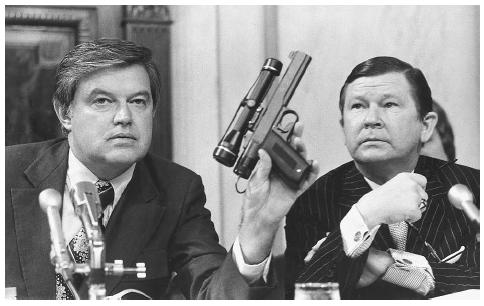
When the committee opened public hearings, Church brandished a gun at the first session. (Idahoans know how to kick ass.) If you're wondering what inspired my new profile pic, it is that gun. Specifically, this was a gun that could be used to fire poison darts. The CIA had plenty of deadly poisons on hand. (In my opinion, the CIA should have just gone to Australia and got box jellyfish.) The committee discovered other exciting stuff as well - for instance, communications companies provided the CIA with telegrams Americans sent abroad. (Today, the CIA routinely listens in on the calls of Americans abroad, or that Americans make to other countries.) The CIA often intercepted mail. You get the idea - lots of domestic surveillance, and the senators themselves were not exempt.
We should not forget something else: the pressure! Death threats! Bugs and wiretaps! Stonewalling! The relentless opposition of Ford and conservatives! Something more insidious arose as well - the idea that the Church committee was unpatriotic, that its very existence was aiding and abetting the Communists. The idea that "I don't have anything to hide, so go ahead and wiretap my phones! open my mail! etc." Now, these ideas did not suddenly arise with the Church committee, but they were encouraged by various right wing groups. You see the parallels, and I can promise you that Obama is under immense pressure to let bygones be bygones - the Bush administration left a big pile of doody, and Obama needs to clean it up. He - and Congress - have a big enough task before them as it is.
I actually have some sympathy for that idea, more than some of y'all might think. But, yanno, over the summer I read the entire report on the Columbia crash. (not the new report, the one that came out in 2004) When something important like the Columbia fails, you gotta find out why. If you don't, you risk another shuttle exploding. So - when prewar intelligence fails, or the economy fails, or (you can make your own list of Bush administration screwups here) - you gotta find out why. But the difference is that, with some of the Bush policies, our moral code failed. Torture is a moral issue to me. Spying on Americans is a moral issue to me. There should be inquiries, and we need to see how far the rot goes (all the way to Bush and Cheney, most likely) - but the more interesting question to me is, why is it perfectly reasonable to torture or to spy or whatever? Why do some people think that way? Are they right and am I totally off base - do we need to do whatever it takes to fight terrorism or communism?
Here's where I'm going - I want to look more deeply into the arguments against the Church committee. Sure, I think they're wrong. But those arguments sure are appealing to many people. Why? Also, I want to do a post on Church today. What would Frank Church think of our current mess? I have no idea, but I will enjoy speculating!
As kind of an amusing sidenote, the Church committee ran over schedule into 1976. That overrun was a problem, because Church ran for president that year. Really. He started his campaign really late, won a few primaries, lost the nomination, did not become Carter's VP. Carter faced a lot of problems in office, and it would have been interesting to see how Church would have handled those problems. Alas, Idaho has not had a presidential contender since then, and my main man Larry Craig is in no danger of becoming president.
The Church Committee - properly the United States Senate Select Committee to Study Governmental Operations with Respect to Intelligence Activities - was formed in 1975 to investigate the CIA, FBI, NSA, etc. It was prompted in large part by the reports of Seymour Hersh, who disclosd that the CIA had investigated antiwar protesters and many others. You know, liberals. What the committee pursued at first was the CIA's attempted assassinations of foreign leaders. (Castro and Patrice Lumumba of the DR of the Congo) The CIA also encouraged dissidents to overthrow certain governments.
When the committee opened public hearings, Church brandished a gun at the first session. (Idahoans know how to kick ass.) If you're wondering what inspired my new profile pic, it is that gun. Specifically, this was a gun that could be used to fire poison darts. The CIA had plenty of deadly poisons on hand. (In my opinion, the CIA should have just gone to Australia and got box jellyfish.) The committee discovered other exciting stuff as well - for instance, communications companies provided the CIA with telegrams Americans sent abroad. (Today, the CIA routinely listens in on the calls of Americans abroad, or that Americans make to other countries.) The CIA often intercepted mail. You get the idea - lots of domestic surveillance, and the senators themselves were not exempt.
We should not forget something else: the pressure! Death threats! Bugs and wiretaps! Stonewalling! The relentless opposition of Ford and conservatives! Something more insidious arose as well - the idea that the Church committee was unpatriotic, that its very existence was aiding and abetting the Communists. The idea that "I don't have anything to hide, so go ahead and wiretap my phones! open my mail! etc." Now, these ideas did not suddenly arise with the Church committee, but they were encouraged by various right wing groups. You see the parallels, and I can promise you that Obama is under immense pressure to let bygones be bygones - the Bush administration left a big pile of doody, and Obama needs to clean it up. He - and Congress - have a big enough task before them as it is.
I actually have some sympathy for that idea, more than some of y'all might think. But, yanno, over the summer I read the entire report on the Columbia crash. (not the new report, the one that came out in 2004) When something important like the Columbia fails, you gotta find out why. If you don't, you risk another shuttle exploding. So - when prewar intelligence fails, or the economy fails, or (you can make your own list of Bush administration screwups here) - you gotta find out why. But the difference is that, with some of the Bush policies, our moral code failed. Torture is a moral issue to me. Spying on Americans is a moral issue to me. There should be inquiries, and we need to see how far the rot goes (all the way to Bush and Cheney, most likely) - but the more interesting question to me is, why is it perfectly reasonable to torture or to spy or whatever? Why do some people think that way? Are they right and am I totally off base - do we need to do whatever it takes to fight terrorism or communism?
Here's where I'm going - I want to look more deeply into the arguments against the Church committee. Sure, I think they're wrong. But those arguments sure are appealing to many people. Why? Also, I want to do a post on Church today. What would Frank Church think of our current mess? I have no idea, but I will enjoy speculating!
As kind of an amusing sidenote, the Church committee ran over schedule into 1976. That overrun was a problem, because Church ran for president that year. Really. He started his campaign really late, won a few primaries, lost the nomination, did not become Carter's VP. Carter faced a lot of problems in office, and it would have been interesting to see how Church would have handled those problems. Alas, Idaho has not had a presidential contender since then, and my main man Larry Craig is in no danger of becoming president.
Saturday, January 10, 2009
Cooper-Church and Case-Church
I regret choosing Frank Church as a pseudonym now. For a liberal in George Bush's America to go by "Frank Church" is like a Catholic going by "Pope John Paul II" or a Latin scholar going by "A. E. Housman". I chose Frank Church as a pseudonym on a whim - how about choosing a little known senator that was a liberal champion and should be more remembered. Perhaps I should have chosen another name, like Charles Mathias, Clifford Case, John Sherman Cooper, or Mark Hatfield. All of those senators are remembered, at least by folks older than me, but none of them stood steadfastly against everything still president Bush stands for. (Interestingly, all four senators I just named were all Republicans. They cooperated with Church on various legislation or committees.)
I guess I wanted to start off by talking about Vietnam. The parallels between Vietnam and Iraq that I see mostly concern the secrecy and obscurity around the conduct of both wars. Why did we wage war in Iraq? Not for WMDs, and the real reason may be forever unknown. Vietnam? The event that started US involvement in earnest was the Gulf of Tonkin resolution. Turns out, that was a fraud too. BTW, Frank Church voted for that resolution. Not one of his finest moments, but he helped us get out of Vietnam later on.
I refer specifically to Cooper-Church and Case-Church, two defining amendments in the struggle to end that stupid war. As you recall, but the Vietnam War encompassed more than Vietnam. Nixon expanded it into Cambodia and Laos. Cooper-Church sought to end fighting in Cambodia and Laos by cutting off its funding. It failed in mid-1970 and passed at the end of 1970. Case-Church pretty well killed off the war. It ended funding for American forces in Cambodia, Laos, and Vietnam. It passed in 1973 and US involvement ended, mostly, on August 15, 1973.
As far as expanding the Iraq war - I've always wondered about that and Bush. I think certain forces in his administration might have been pushing him to declare war on Iran. Cheney especially, a lot of Pentagon folks, perhaps the Israeli government. Iran doesn't particularly scare me - remember, it's a Third World country - but I can see how it would scare Israel. And pretty much everyone in government supports Israel. Some support Israel because they're Jewish. That's good. Some support Israel because it's our only democracy in the Middle East. (That's why I think Israel should absolutely exist, although calling Israel a democracy comes with troubling caveats.) And some, my favorite, support Israel because the existence of Israel is a precondition for the Rapture, Armageddon, Second Coming, etc.
Anyway! I wish Congress had been a little more forthright in talking about cutting off funding for the war. I think Iraq has been pretty eclipsed in our consciousness by our new depression - and before that the American public was pretty solidly against the war. Of course, it's an open question how much the American public would support cutting off funding for the Iraq war. But - Congress controls the purse strings. Congress finances the war. If you want to end a war, the best thing to do is stop the funding. Stop the money. And our Congress never had the testicular fortitude to do that. (Ironically, Frank Church had testicular cancer as a young man.)
Maybe I'll ramble my way into talking about Vietnam fallout tomorrow.
I guess I wanted to start off by talking about Vietnam. The parallels between Vietnam and Iraq that I see mostly concern the secrecy and obscurity around the conduct of both wars. Why did we wage war in Iraq? Not for WMDs, and the real reason may be forever unknown. Vietnam? The event that started US involvement in earnest was the Gulf of Tonkin resolution. Turns out, that was a fraud too. BTW, Frank Church voted for that resolution. Not one of his finest moments, but he helped us get out of Vietnam later on.
I refer specifically to Cooper-Church and Case-Church, two defining amendments in the struggle to end that stupid war. As you recall, but the Vietnam War encompassed more than Vietnam. Nixon expanded it into Cambodia and Laos. Cooper-Church sought to end fighting in Cambodia and Laos by cutting off its funding. It failed in mid-1970 and passed at the end of 1970. Case-Church pretty well killed off the war. It ended funding for American forces in Cambodia, Laos, and Vietnam. It passed in 1973 and US involvement ended, mostly, on August 15, 1973.
As far as expanding the Iraq war - I've always wondered about that and Bush. I think certain forces in his administration might have been pushing him to declare war on Iran. Cheney especially, a lot of Pentagon folks, perhaps the Israeli government. Iran doesn't particularly scare me - remember, it's a Third World country - but I can see how it would scare Israel. And pretty much everyone in government supports Israel. Some support Israel because they're Jewish. That's good. Some support Israel because it's our only democracy in the Middle East. (That's why I think Israel should absolutely exist, although calling Israel a democracy comes with troubling caveats.) And some, my favorite, support Israel because the existence of Israel is a precondition for the Rapture, Armageddon, Second Coming, etc.
Anyway! I wish Congress had been a little more forthright in talking about cutting off funding for the war. I think Iraq has been pretty eclipsed in our consciousness by our new depression - and before that the American public was pretty solidly against the war. Of course, it's an open question how much the American public would support cutting off funding for the Iraq war. But - Congress controls the purse strings. Congress finances the war. If you want to end a war, the best thing to do is stop the funding. Stop the money. And our Congress never had the testicular fortitude to do that. (Ironically, Frank Church had testicular cancer as a young man.)
Maybe I'll ramble my way into talking about Vietnam fallout tomorrow.
Friday, January 9, 2009
So who was Frank Church anyway?
For Christmas I got a biography about Frank Church, called Fighting the Odds. I finished it today. It's a pretty powerful book - Church was in the senate for 24 years, 1957-1980, and he was involved with all the important events of the time, most specifically Vietnam and its fallout.
Maybe I can start with my important thought: While reading the book, I perceived a lot of uncomfortable parallels between Nixon (to a lesser extent, Ford and Carter) and still president Bush. Perhaps the most clearcut one is between Vietnam and Iraq. Now, after Nixon resigned and the Vietnam clusterfuck ended, Congress reasserted its authority. Church, being a senior Democrat, was naturally involved in ferreting out the wrongdoing and numerous misdeeds of Nixon and more importantly the "Unitary Executive". Will the wrongdoing and numerous misdeeds of Bush be investigated by the new 111th Congress? Will there be any Churches ready to scavenge among the Bush detritus and chair special subcommittees?
(My answer: don't hold your breath.)
So that's Church! A brave courageous fellow, especially considering he was a liberal Democrat from Idaho. He was the only Democratic senator from Idaho to be elected to multiple terms. John McCain got 61.5% of the presidential vote, and the Republican percentages have been persistently high since 1960. Idaho elected its first Democrat to Congress since 1992 in 2008, and that man, Walt Minnick, is something of a fluke. (He was running against an extremely unpopular incumbent.) What I am trying to emphasize is that Frank Church was even more of a fluke, and it's amazing that he was a senator at all.
How did he do it?
Constituent service. Like most Western congressmen, he was on the Interior Committee. He had a fine grassroots organization during his elections. He went to a bunch of dinky little towns and gave many speeches. He was popular with the Mormons - he was a real straight arrow type. He was no Eliot Spitzer - much less Larry Craig. He was devoted to his wife. His wife was a pretty amazing political asset. He was willing to defend his stances, even when they were unpopular. Let's not forget misconceptions - a lot of Idahoans thought he was moderate or conservative. He was conservative on some issues. He opposed gun control, like any Western politician. He wasn't exactly pro-life, but he sided with the pro-life crowd on some issues. He was temperamentally conservative.
I guess that's my list of why he lasted four terms. He was defeated in 1980, the Reagan landslide year. Some conservative groups (analogous to today's 527's) spent a bunch of money softening him up, emphasizing all of his stands that were unpopular in Idaho. His most unpopular action was probably playing a key role in the Torrijos-Carter treaties, which returned the Panama Canal to Panama in 1999. His opponent was a fellow named Steve Symms, an extremely conservative congressman from Idaho's 1st district. He was up against a mighty tide, a conspiracy of circumstances. Amazingly, he lost by one percent.
(My analogy to this is pretty dreadful, but hey, it's my blog: Pennsylvania is a fairly moderate to liberal state. Rick Santorum was dreadfully conservative and a two term senator. In 2006, with a strong Democratic tide, he lost by 19 or so percent. That's why I think Church's narrow loss is quite amazing.)
But let us not dwell on Idaho politics! (Summary: Idaho's conservative.) Let us talk instead of Church's important legislation, of the United States Senate Select Committee to Study Governmental Operations with Respect to Intelligence Activities, of Church's subcommittee on multinationals, of Church's memorial. Let us talk about that tomorrow.
Except for Church's memorial. Church is rightfully most famous for his efforts to uncover wrongdoing by the various intelligence agencies, but he was also a conservationist. Here is his memorial.
Maybe I can start with my important thought: While reading the book, I perceived a lot of uncomfortable parallels between Nixon (to a lesser extent, Ford and Carter) and still president Bush. Perhaps the most clearcut one is between Vietnam and Iraq. Now, after Nixon resigned and the Vietnam clusterfuck ended, Congress reasserted its authority. Church, being a senior Democrat, was naturally involved in ferreting out the wrongdoing and numerous misdeeds of Nixon and more importantly the "Unitary Executive". Will the wrongdoing and numerous misdeeds of Bush be investigated by the new 111th Congress? Will there be any Churches ready to scavenge among the Bush detritus and chair special subcommittees?
(My answer: don't hold your breath.)
So that's Church! A brave courageous fellow, especially considering he was a liberal Democrat from Idaho. He was the only Democratic senator from Idaho to be elected to multiple terms. John McCain got 61.5% of the presidential vote, and the Republican percentages have been persistently high since 1960. Idaho elected its first Democrat to Congress since 1992 in 2008, and that man, Walt Minnick, is something of a fluke. (He was running against an extremely unpopular incumbent.) What I am trying to emphasize is that Frank Church was even more of a fluke, and it's amazing that he was a senator at all.
How did he do it?
Constituent service. Like most Western congressmen, he was on the Interior Committee. He had a fine grassroots organization during his elections. He went to a bunch of dinky little towns and gave many speeches. He was popular with the Mormons - he was a real straight arrow type. He was no Eliot Spitzer - much less Larry Craig. He was devoted to his wife. His wife was a pretty amazing political asset. He was willing to defend his stances, even when they were unpopular. Let's not forget misconceptions - a lot of Idahoans thought he was moderate or conservative. He was conservative on some issues. He opposed gun control, like any Western politician. He wasn't exactly pro-life, but he sided with the pro-life crowd on some issues. He was temperamentally conservative.
I guess that's my list of why he lasted four terms. He was defeated in 1980, the Reagan landslide year. Some conservative groups (analogous to today's 527's) spent a bunch of money softening him up, emphasizing all of his stands that were unpopular in Idaho. His most unpopular action was probably playing a key role in the Torrijos-Carter treaties, which returned the Panama Canal to Panama in 1999. His opponent was a fellow named Steve Symms, an extremely conservative congressman from Idaho's 1st district. He was up against a mighty tide, a conspiracy of circumstances. Amazingly, he lost by one percent.
(My analogy to this is pretty dreadful, but hey, it's my blog: Pennsylvania is a fairly moderate to liberal state. Rick Santorum was dreadfully conservative and a two term senator. In 2006, with a strong Democratic tide, he lost by 19 or so percent. That's why I think Church's narrow loss is quite amazing.)
But let us not dwell on Idaho politics! (Summary: Idaho's conservative.) Let us talk instead of Church's important legislation, of the United States Senate Select Committee to Study Governmental Operations with Respect to Intelligence Activities, of Church's subcommittee on multinationals, of Church's memorial. Let us talk about that tomorrow.
Except for Church's memorial. Church is rightfully most famous for his efforts to uncover wrongdoing by the various intelligence agencies, but he was also a conservationist. Here is his memorial.
Subscribe to:
Posts (Atom)